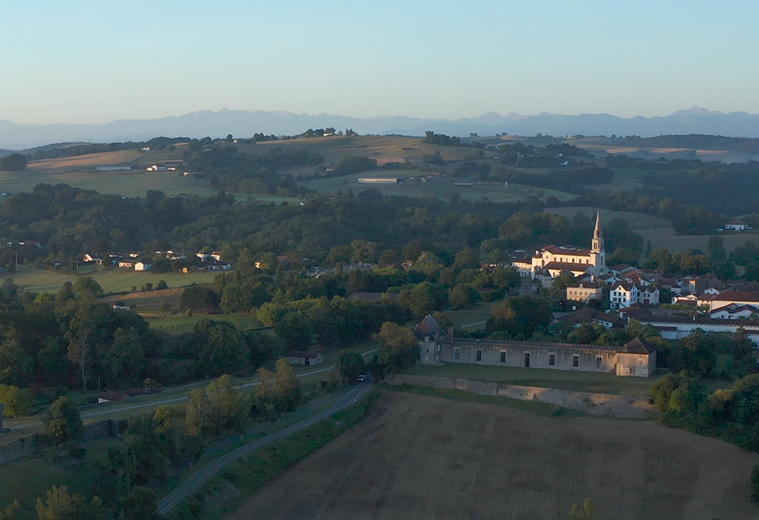
The duchy and peerage of Gramont
The duchy and peerage of Gramont is a small duchy in what is now the department of the Pyrénées-Atlantiques, centred on the village of Bidache, some thirty kilometres east of Bayonne in the Agramont country, at the point where Lower Navarre, Labourd, Gascony and Béarn meet.
Creation and extent of the duchy
It was created by letters patent of Louis XIV, King of France and Navarre, issued in November 1648 and registered on 15 December 1663, following the elevation of the Count of Gramont to duke by brevet and peer by letters patent of 31 December 1643.
The duchy comprised ten parishes. Six lay entirely within the kingdom of France: the Labourd parishes of Urt, Bardos and Guiche, and the Gascon parishes of Sames, Léren and Saint-Pé-de-Léren. One, Came, lay partly in France and partly in Navarre. Three lay in Navarre: Bergouey, Viellenave-sur-Bidouze (today combined as Bergouey-Viellenave) and Escos.
It should not be confused with the sovereignty of Bidache, another territory under the jurisdiction of the dukes of Gramont in the same area, whose limits correspond exactly to those of the small town of Bidache. The duchy of Gramont was in fact made up of two separate portions, divided by the territory of the sovereignty.
The lordship of Gramont
Before becoming a duchy, Gramont was a feudal lordship that appears in the archives from 1040 onwards. The castle that gave it its name is not the present Château de Gramont at Bidache but stood on the hill known as La Mulari, in the territory of Viellenave-sur-Bidouze in Navarre.
The county of Guiche
Before attaining ducal rank, the Gramont family had their land of Guiche raised to a county, the title of Count of Guiche being borne by the eldest son of the house. The county of Guiche was created by King Charles IX in 1563 and was made up of the French parishes of Bardos, Urt, Sames, Came, Saint-Pé-de-Léren and Briscous.
The county of Gramont
According to the history and genealogy of the House of Gramont published in 1874 by Agénor de Gramont, King Charles IX also raised Gramont to a county on the same date. Jean de Jaurgain, with some plausibility, regards this as an error, since Gramont, being a land of Navarre, did not come under the King of France. Even so, the letters patent creating the duchy of Gramont do refer to the land and county of Gramont.